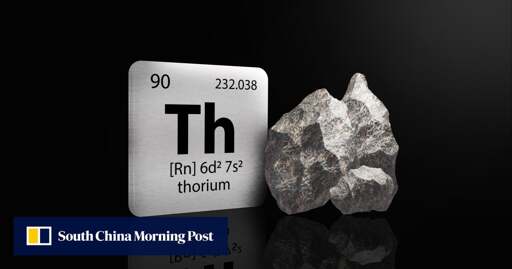
It marks the first long-term, stable operation of the technology, putting China at the forefront of a global race to harness thorium – considered a safer and more abundant alternative to uranium – for nuclear power.
The experimental reactor, located in the Gobi Desert in China’s west, uses molten salt as the fuel carrier and coolant, and thorium – a radioactive element abundant in the Earth’s crust – as the fuel source. The reactor is reportedly designed to sustainably generate 2 megawatts of thermal power.
Who still thinks the South Chinese Morning Post is a legit source after what happened to Hong Kong needs a reality check.
SCMP is one of the most libshit news in China
Also, chill it cracker, it’s news about a reactor, we don’t need your state dept. programming here
Yeah, let’s wait until a reliable source like fox news or CNN confirms it.
Joined 2 weeks ago, spews bs & propaganda.
Also, “cracker” ?? 🥴🤣 Is this supposed to be some very dangerous insult lol
And we certainly don’t need your tankie shit here.

Go back to whatever chudhole you came from.
Chuds would probably try to doxx them for daring to say “cracker” lol
SCMP has always sided with mainland China on crux issues, but I’ve read them on and off for nearly 10 years now and have found them to be very reliable.
In fact, this is exactly what the Wikipedia page for reliable sources says about it too: https://en.m.wikipedia.org/wiki/Wikipedia:Reliable_sources/Perennial_sources
For anyone not familiar with thorium…
Thorium is a great nuclear fuel. Much much safer than the uranium we currently use, because the reaction works best only within a narrow temperature band. Unlike uranium which can run away, a thorium reactor would become less efficient as it overheats possibly preventing a huge problem. That means the fuel must be melted into liquid to achieve the right temperature. That also provides a safety mechanism, you simply put a melt plug in the bottom of the reactor so if the reactor overheats the plug melts and all the fuel pours out into some safe containment system. This makes a Chernobyl / Fukushima style meltdown essentially impossible.
There are other benefits to this. The molten fuel can contain other elements as well, meaning a thorium reactor can actually consume nuclear waste from a uranium reactor as part of its fuel mix. The resulting waste from a thorium reactor is radioactive for dozens or hundreds of years not tens of thousands of years so you don’t need a giant Yucca Mountain style disposal site.
And thorium is easy to find. Currently it is an undesirable waste product of mining other things, we have enough of it in waste piles to run our whole civilization for like 100 years. And there’s plenty more to dig up.There are challenges though. The molten uranium is usually contained in a molten salt solution, which is corrosive. This creates issues for pipes, pumps, valves, etc. The fuel also needs frequent reprocessing, meaning a truly viable thorium plant would most likely have a fuel processing facility as part of the plant.
The problems however are not unsolvable, Even with current technology. We actually had some research reactors running on thorium in the mid-1900s but uranium got the official endorsement, perhaps because you can’t use a thorium reactor to build bombs. So we basically abandoned the technology.
China has been heavily investing in thorium for a while. This appears to be one of the results of that investment. Now this is a tiny baby reactor, basically a lab toy, a proof of concept. Don’t expect this to power anybody’s house. The point is though, it works. You have a 2 megawatt working reactor today, next you build a 20 megawatt demonstrator, then you start building out 200 megawatt units to attach to the power grid.
Obviously I have no crystal ball. But if this technology works, this is the start of something very big. I am sure China will continue developing this tech full throttle. If they make it work at scale, China becomes the first country in the world that essentially has unlimited energy. And then the rest of the world is buying their thorium reactors from China.
deleted by creator
It’s a matter of implementation versus invention.
If I asked you to build a hundred story skyscraper, that would be difficult, but we already have all of the technical components. All the component problems are already solved- we know how to make high quality steel, we know how to design the frame of such a building, we know how to anchor it into the ground, etc. You just need to put those technologies together in a functional design.
If I asked you to build me a spacecraft that goes faster than light, you couldn’t, because that sort of propulsion system has never been built. And while we have theories on how one might build it, we don’t currently have the capability to build any of those theoretical drive systems even as test articles (mainly because they need things in space larger than we have the capability to launch or will have the capability to launch anytime soon).
But if I asked you to build a thorium reactor, all of the component problems have been solved. We have a lot of coatings that resist corrosion, and so making valves and pipes out of them (and more importantly, designing the system of valves and pipes) takes work but we know how to do it. We understand how to make and process thorium fuel, even if we don’t have much experience doing it.
As for your grid, I don’t want my grade either powered by text that isn’t safe reliable and productive, but the fact is we don’t have that right now. A lot of power still comes from coal and similar shitty sources. So I will absolutely take less shitty.
Yeah I use the word if a lot, but that has a level of probability associated with it. I can say if we figure out a way to generate power from magic pixie dust tomorrow our energy problems will be solved but there’s no probability of that. Here there is a technology that has been known to work since the 1900s, that we have built research reactors on, and that is now being actively developed. The “if” here has a high degree of probability.
Very nice explanation and only nitpicking, but saying that Thorium is much much safer than uranium implies that uranium nuclear plants are unsafe. In reality uranium nuclear power has one of the best safety records in energy production.
Uranium reactors are for the most part very safe, and I personally think we should consider building more of them. The problem with them is when something goes wrong, it can go very very wrong contaminating a huge area. Now granted more modern reactor designs make that sort of issue much less likely, but the worst case scenario of a uranium reactor, no matter how unlikely, is still a lot worse than the worst case scenario of a thorium reactor.
deleted by creator
Neutrons?
deleted by creator
Neutrinos almost don’t interact with other matter. You use neutrons to start fission
deleted by creator
Literally nothing you just said is correct.
Mathematics of wonton burrito meals, got it.
You do realize you’re on the internet, right? You can look things up first instead of spouting bullshit.
Thanks for a thorough explanation.
You absolutely can make a nuke out of thorium-derived material (first in Teapot MET, 1955, then possibly later by India). It’s not widely used because plutonium is similar and in some important ways superior material
The tradeoff in using salt as fuel/coolant is that now almost all the fission products are in soluble form, instead of nice ceramic chemically inert pellets, which makes any spill much worse, and i wouldn’t say it’s safer for this reason - it’s different, and it’s a tradeoff few thought it is worth making. We have figured out how to make PWRs not explode so it’s not that big of a problem. This goes both for uranium or thorium as a fuel
The reason Yucca Mountain is needed is that nuclear waste exists, if US reversed their policy on reprocessing maybe it wouldn’t fill up so quickly. It’s a matter of political will
At least now, the chemical engineering for reprocessing fuel when reactor is on is not there. Maybe it’ll get developed in this project, but this didn’t happen yet. It all has to be weighed against existing alternatives, and it’s possible to breed 233U in normal water-based reactors, so maybe there’s a little reason to make MSRs in the first place. India has some thorium energy projects as well, but they’re slowed down by lack of fissile material to bootstrap it (you can’t fuel reactor using thorium only, it needs some fissile material)
interesting, india has 25% of known deposits, thorium reactors would be very useful for them. https://www.worldatlas.com/articles/list-of-countries-by-thorium-reserves.html
The resulting waste from a thorium reactor is radioactive for dozens or hundreds of years not tens of thousands of years so you don’t need a giant Yucca Mountain style disposal site
That is assuming they don’t make significant amounts of Fe-60 (2.6 My half-life) by exposing steel pipes to neutron flux. While the fuel itself might have a shorter half-life, other waste still needs to be dealt with.
Scientific advances from China need to have outside confirmation. Because, propaganda and all that
I cannot speak for this area of science, but in my field China’s research papers, for example rock mass failure response to complex stress states, are like a god send, really quality work. This is my opinion in my field but if I had to extrapolate… Remember the Soviets with all their propaganda had amazing scientists
They’re also crushing it in the ML space. Half the good AI papers are written in Chinese; one of the startups I worked at had the luxury of hiring a Chinese speaking AI researcher who could read them for us
Yeah, they had way more horrifying ones:
Yes, there were heavy mistakes made, from making stupid decisions to giving positions of power to people who should had been fired. But this happened everywhere, for example the big use of lobotomies to the red scare that caused many scientist like Oppenheimer to get in trouble with the US goverment.
Yes, I remember when Oppenheimer got in trouble, which resulted in all the decent doctors in the country being rounded up and executed based on lies.
Good thing only Our Enemies use propoganda
totally unrelated but did you hear Tesla’s are at MOST two years away from breaking 1000km range? well they were in 2015. so they’ll definitely have a thousand km range in 2017. I guess we need to see if time really is cyclical and this is for the next cycle’s 2017
Good news, mankind should be pushing farther into this technologies… so we finally have our first gen IV reactor? I honestly thought we would never reach them on time.
Plus Thorium rocks
deleted by creator
The government agencies that enforce those standards have been gutted in the US. So. Next point?
I will assume you are European and the above point does not apply as sharply to you, but western empire decay and corruption is slowing eating away all of your criticisms of China.
But freedom of expression! How is that going for you?
But communism! How is capitalism going for the average citizen?Anyway.
This is an amazing breakthrough, the citizens of China are lucky to have a government that seems to care about the well-being of their citizens and plan for the future. For some reason, westerners cannot accept good news from China without feeling that the world is a zero sum game. It’s not, Chinese citizens have a brighter future than us in the west because we have allowed corporations to purchase our governments at wholesale prices.
China is not to blame, well done to China.
This technological breakthrough is amazing, yes, but does not make disappear the constant harassment of minorities, the lack of freedom, the labor camps, the violent repression in Hong-Kong and all the other freaking shit China does on a daily basis.
And thanks for asking about the freedom of expression in Europe, it’s going really fine.
Do you do this for your own country and its allies, insist that every issue with it is brought up every time it’s mentioned regardless of context, or do you reserve it for the countries that are your countries enemies?
Also, try anti-genocide protestors in Germany that freedom of expression is going fine, lol.
I’m not a patriot. I dont give a shit about my own country. If France is does positive things, good, but it doesn’t I’m going to ignore that our politicians are corrupt or that the Olympics were used to enforce mass surveillance and lock up climate activists.
Constant harassment of minorities, lack of freedom, labor camps (El Salvador), violent repression (coming soon). But enough about the United States. Will neoliberalism reach you next?
You do agree that America Bad, don’t you?
Say The Thing.
Of course it’s bad. It’s awful. Only a complete moron would think the opposite.
And you agree that Germany is bad, right? Say the thing
Uh, what about the THTR-300 that operated at 300MW capacity from 1987 to 1989?
https://en.m.wikipedia.org/wiki/THTR-300
It was a total failure, though. Not quite Chernobyl, but it was plagued by incidents.
Honestly, I’m not a nuclear physicist by any stretch of the imagination, but I’m not sure how they plan to emergency cool the reactor to prevent a meltdown if it’s filled with molten salt. Anything colder than molten salt going into the reactor would cause it to be clogged up by not-molten salt.
At least the THTR seemed to have cooling capabilities as the foremost priority.
They put a plug in the bottom that melts if the salt gets too hot and it drains out into a tank that stops the reaction with no moving parts or anyone controlling it. After it cools down they can remelt it and put it back in.
Is this real? Pretty cool if they can actually stop the reaction with such
From what I’ve watched & read, it’s usually depicted as the freeze plug melts and the liquid salt flows into multiple small holding tanks below it. That way the fuel mass will be physically separated, which helps stop fission on top of any other mitigations like lining the containers with neutron absorbers, etc.
Yes I remember reading about this a while back. It’s one of the main reasons thorium rectors are so much safer.
I remember reading about this one, able to fit in a small area and be moved, but never knew if it was thorium
https://interestingengineering.com/innovation/safe-micro-nuclear-reactor-truck
Haven’t read up on much of it, just remembered it in passing.
Refreshing not to see the comment section full of anti-nuclear brainlets. For a second I thought Lemmy was a Greenpeace hot-spot.
Anyway…
One good turn deserves another. If others won’t follow because of good example, hopefully other countries will instead follow because of competition.
deleted by creator
Yes. I’ll be an asshole to those that stand in the way of good things. No remorse.
deleted by creator
deleted by creator
Tell me you don’t know anything about nuclear energy without saying you don’t know anything about nuclear energy.
deleted by creator
I know enough to know that if you’re worried about pollution from Nuclear then you should be worried about all the waste products in production of solar panels which can be extremely toxic. And that if you’re specifically talking about the amount of radiation a megawatt reactor will produce in it’s life time you should never venture anywhere close to a coal burning plant because the amount of radioactive material they let loose into the atmosphere is orders of magnitudes greater than you could get from a uranium reactor, with thorium reactors being predicted and shown in small scale testing to have significantly less dangerous byproducts left over. With several theories and proposed designs for fusion and thorium reactors that could recycle spent fuel and further reduce the amount of high level waste a facility would have at the end of it’s life cycle, because unlike all other forms of energy generation, the nuclear facilities contain and keep their waste products on site for decades and only transfer it off site during decommissioning.
deleted by creator
Radioactive nuclear materials comes from the Earth. All one has to do is put it back in the Earth. Finland built a massive underground nuclear waste storage facility, but there are also technologies being developed to reclaim nuclear waste (because only a very small amount if the material actually gets used in the fission process).
deleted by creator
deleted by creator
We need to store the waste for thousands of years. This is bad. We are able to recycle the waste for more power but we’re not allowed to because it produces a tiny bit enriched uranium and that’s not allowed by the pact the US and Russia made. But recycling waste is tech from the 70’s and it can reduce the half life of 100.000 years to 100 years.
Thorium however, is a different story. It doesn’t work with gamma radiation but with alpha radiation. Alpha radiation is the most dangerous form of radiation, but it doesn’t go far and doesn’t go through many things. You can contain it with a piece of paper. Gamma radiation is the least harmful form of radiation but the big issue is it goes really far and goes through almost anything.
So waste from a Thorium reactor is much less harmful, easy to contain, also has a very short half life (I don’t know how long but it’s really short, as in several years) so Thorium really is awesome. Thorium is also a waste product of many other mining operations so it’s already a form of recycling. The downside of a Thorium reactor is that it’s far more complex than the reactors we know so it’s very hard and expensive to build, more than a regular reactor. So it will cost a lot, takes a long time, but it’s an extremily safe and wise investment.
deleted by creator
Yeah but traditional nuclear power can be with much less waste which has a much shorter half life if we recycle the waste, is my point. Less than 100 years instead of thousands. But the recycling process which dates from the 70’s is banned because the process also provides a tiny bit of enriched uranium.
So I’m not against traditional nuclear power, I think we can do much better if we recycle, plus Thorium reactors are a good addition.
so thorium is harmless… unless you eat it.
Don’t eat Thorium kids!
It’s a lot simpler than the majority of humanity reverting to pre-industrial lifestyles.
deleted by creator
Yeah, thorium reactors can’t meltdown because they need to constantly being powered by thorium, sick you can find anywhere. There’s a 2008 or so bill gates Ted talk on nuclear power that talks about it. For better or worse, china is going to lead the world regarding energy (and economy, seeing all those trump tariffs)
deleted by creator
That’s what I tell my partners. They are, thus far, unimpressed.
Me opening the comment section knowing that its just gonna be a bunch of racism… like i get it i hate the chinese government as well but give credit to the millions of scientists and people who are actually trying to make life better on this earth. If something isnt american, it can still be nice to have.
I personally believe the CCP is doing an amazing job. Communism is working wonderfully
Authoritarianism is winning.
It’s not communism, it’s state-capitalism
I don’t think it’s communism anymore but the Chinese gov are actually looking after their own citizens in my opinion. I kind wish Xi was in charge of the UK honestly.
They tend to think of everything long term and all of those projects are paying off, also Healthcare free education etc they are investing more in their own population than anyone else. US is in my opinion as UK guy pretty much done they’ve picked a fight that they won’t win.
“Anymore” as if it ever was. Even USSR never claimed to be a communist country
P.S. They claimed to be a socialist, then “developed” socialist country that’s “on the path of building communism”.
I don’t know what they are but I know they look after their citizens more than we do, and they’ve really started taking over the entire Tech space in the last few years mainly due to that.
I’m UK but if someone held a gun to me and demanded where would I live USA or China I’d honestly pick China.
I’m Kinda looking forward to the US picking a war then realising China has quantum radar etc and getting schooled, hopefully it doesn’t go Nuclear but I’d still put my own money on China winning.
I’d advise you to read more on how Chinese government and spin dictatorships work. There’s a really good book written by Treisman and Guriev
It’s not really a country you’d choose over US even despite all it’s massive (cough healthcare and consumer protections cough) flaws
Communism is a goal, not a government system.
Idk… I have my ifs and buts about China. If you don’t believe in human rights, well love China! I’m not saying everyone in China is bad (but there are evil individuals like in US and NK). And watching Human Harvest, jeez…
The “human rights” standard of western imperialist countries is laughable hypocrisy. The US alone makes China look like the paragon of justice.
Tell it to the Uyghurs.
Fake ass western propaganda “genocide” my ass
You’re uncritically guzzling the CIA line
All of the supposed “evidence” comes from Adrian Zenz, who is a religious zealot who thinks it is his “god-given mission to destroy China.”
https://medium.com/@braisedporkblog/debunking-the-uyghur-genocide-a-resource-list-a31dd0ea3d87
Your username is very accurate. You uncritically accept Tankie propaganda supplied by a totalitarian dictatorship.
Tell it to the American Blacks in prison. Glass houses. We’re all bad.
They’re not being subjected to a genocide.
Human rights they have they do execute billionaires who try to screw the rest of the population which in my opinions puts them ahead even more
Whatever that link is it doesn’t load for me, UK censorship I guess.
Where do you get racism? Did you just want to complain about racism?
Too lazy to scroll down an inch or two to see the comments questioning the tech just because it’s China or making unrelated anti-China comments?
Again, what the hell does that have to do with race? China is not a race.
Anti-China comments aren’t the same thing as anti-Chinese comments.
Same thing. You westerners just don’t like acknowledging when your designated adversaries make progress because of your exceptionalism.
? Taiwan is actually producing innovation and tech, whereas PRC for the most part stifles it. Both are Chinese, except the former actually has a track record with their claims.
Immediately does what I just described
How are you this propagandized? Do you have like no thinking at all, aside from what your corporate media tells you?
Thorium tarnishes to olive grey when exposed to air. This makes it kinda greenish. Green is the color of stamina, so this checks out.
Then why isn’t viagra green? Checkmate!
It’s temporary stamina, so it’s the cyan at the end of the green bar.
If you’re feeling out of breath, drink a thorium potion!
It’s got electrolytes!
If I drink the blue potion, I get tingly and my skin starts sloughing off. Must be the cobalt.
deleted by creator
this is toy sized reactor, not even entire technology demonstrator, there are medical isotope/research reactors with power 20MWt and more
This is such a weird comment, full of “NiCd batteries aren’t good enough so solar/wind are useless because we can’t store the power” energy.
It’s a test reactor, it’s meant to be smaller than the “big boys”, and in a few years it’ll be smaller and more efficient.
Sure, it’s not going to singlehandedly power an entire country, but distributed power is better than localized. 1000 small reactors placed all over means less likelihood of system wide failure than a handful of large ones.
When state-level funding for SMRs is available, it just makes more sense to build normal, GWe-sized reactors instead. For everything else, look up https://awful.systems/comment/7019440
deleted by creator
take the thinly veiled racism elsewhere
what the fuck are you talking about
OK, but do they run on Thorium?
There were small reactors that ran on thorium. Scaling up all the necessary molten salt processing will be pretty hard thing to do, if this thing can even run continously that is
The article makes it very clear its running continuously, which is what they are celebrating. They have successfully refueled it while operating, which is a huge part of the “continuous.”
The article is all of 6 paragraphs. It’s not a difficult read.
As someone that often works for multiple years on pilot and poc projects, can we stop calling those “toys”.
Sorry we don’t have madscientist money here.
i will call MSRs (not thorium power, this is fine) toys until a single 100MWe+ unit gets built up. wanna bet that it won’t happen in 20 years?
In this context what does poc mean?
Proof of concept.
Why can’t we spend $20 billion on a full-scale reactor that may very well not work? Why is science so slow?
Science doesn’t have to be slow. Politics and funding are usually the bottleneck.
yeah either that or sometimes that one biologist illegally gene-editing embryos shows up
Yes, but if you increase the funding, they will say “Why is science so expensive?”
The article makes it very clear its running continuously, which is what they are celebrating
i think you’ve read different article
Chinese scientists have achieved a milestone in clean energy technology by successfully adding fresh fuel to an operational thorium molten salt reactor, according to state media reports.
That reactor is 2MWt, which is still somewhere about 1000x smaller than actual production reactors. But this is not the issue here, because in MSR the reactor is not the hard part, it’s its entire fuel cycle.
The entire point of having fuel as a solution instead of hard, nonreactive ceramic pellets put in tubes made of refractory metal is that there could be perhaps a way to extract fission products from coolant/fuel, which would prevent neutron capture by these fission products, which makes in turn better use of neutrons, so more fissile material can be bred. Benefit of this is that if that online recycling process can be made to work (big if - unsolved for now) then reactor works always like it’s been freshly refueled. The hard part here is not reactor, it’s the cleaning of fuel while reactor is still online. This has not been demonstrated, instead only new fuel was added, which is something that can be done with CANDU and some other designs where reactor is divided into channels
First attempts at something like this used heavy water acidified solution of uranium nitrate, but this proved too corrosive and also water needed to be pressurized, and also it decomposes when subjected to radiation in this way. Today what is used is FLiBe, which is low-melting salt that doesn’t decompose in this manner, but also is more corrosive and in different ways than water as used in PWRs. If that was the only problem, we would have MSRs left and right, but there are three other big problems
Recovery of excess bred 233U or removal of neutron-absorbing fission products from FLiBe is hard, because you can’t use normal methods used in nuclear reprocessing. There’s no extraction like in PUREX, there’s no ion exchange resin that can survive it, there’s only fluoride volatility and some electrochemical methods, and it all would require significant research before anything close to viable comes up. The salt also probably has to be kept anhydrous at all times. This is the first problem. Maybe this reactor will be used for it, maybe it’ll fail, but there’s a related Problem that doesn’t appear in more conventional reactors. In normal case, you can just leave fuel elements in water until the spiciest isotopes decay so that you don’t have to deal with them. Here, we intentionally work with freshly irradiated, so ridiculously spicy fuel, and intentionally concentrate the most radiotoxic isotopes that are out there. Worse than that, all these fission products are not in form of chemically inert ceramic, these are in form of water soluble fluoride salts and this means that if anything of this gets into soil, it’ll dissolve meaning that either fuel leak or waste stream leak would have much more severe consequences than if it was in conventional form. If you’re trying to say that MSRs are safer for some reason, i’d have some serious reservations.
The other problem is that FLiBe is a good moderator, meaning that any MSR reactor design using this salt is thermal reactor, and we already have this figured out in form of PWRs where we can use water instead. Look up India’s plans for thorium power - they want to use PWR reactors for breeding 233U, with heavy water or not, because this already works and there’s no actual reason for use of this highly experimental and uncertain technology. Keeping fuel rods in reactor for longer time is not an actual showstopper like it was expected in 60s when this concept first surfaced, in fact with advancement of nuclear technology burnup only goes up, i think it already is 2x or 3x what it used to be in early commercial power reactors. If MSR was the only way to make breeding work, we’d probably take effort to manage ridiculous radiotoxicity of this fuel mix, but because both chemical engineering to do so is not there and alternatives that don’t have this problems exist, we don’t. Charitably i’d could describe MSR fuel cycle idea as an highly experimental but promising while also requiring significant research expense. Less charitably, looking at all those years of research yielding nothing, i could also describe it as a dead end grift. You decide
Note that all these problems come up with use of MSR, not thorium. Thorium for nuclear power is fine, but requires reprocessing, and some countries don’t want to do this for diplomatic reasons (americans specifically) (tho i suspect it’s masking the actual reason: some bean counter at westinghouse calculated it’s cheaper to use fresh uranium instead - reprocessing is a lot of dangerous, well-paid, complicated work - in countries where labour costs are lower, or where govt is willing to pay up to have reserve of nuclear material, which amounts to all other countries that have sufficiently advanced nuclear industry, reprocessing does happen. french, chinese, russians, indians, japanese, koreans, and probably a couple more do reprocess their fuel. there’s a couple of countries that send their fuel to manufacturer, and some just discard it underground without reprocessing) (this is also why yucca mountain filling up is a problem of entirely american making, and the only thing that is lacking in order to solve it is political will)
deleted by creator
Thanks for the archive link, OP. Shit that site was cancerous