American cars suck.
Donald Trump is the new US President, and you’re responsible.
Credit scores only exist in the US. Everywhere else just compares your income to your debt.
Australia is trying to bring it in though.
What? We have credit scores in the UK. Used for getting mobile phone contracts, housing, banks, credit cards, loans, etc.
Huh… Well assumptions and monoliths make fools of us all
The UK is just the “light” version of the US
Uh, no, not really.
The British attitudes to work, social systems and regulatory standards are more closely aligned with the EU than the US, even post-brexit.
We are very diplomatically aligned with the US as a result of our historical/cultural overlap and trading relationship, though.
post-brexit
True, doesn’t sound to me like anything the US would do xD
I don’t think the US would leave the EU given they’re not in it xD
To be serious, the sentiment behind Brexit is the exact kind of sentiment you see in US people/politics as well: right-wing propaganda, xenophobia, resistance against any kind of authority, nationalism.
UK is literally the parent of the US. Puritan culture flows through both. A national superiority complex (which you seem to be a slight victim to). Surveillance capitalism. Deregulation.
Yes, the issues in the UK aren’t as severe as in the US, they are more aligned with EU/socialist values, but that’s why I said it’s the “light” version of the US, didn’t say they are the same. But out of all European countries, the UK is definitely the most similar to the US by a large margin.
Edit: also, Brexit is basically the same as the thoughts of some Republican states like Texas seceding from the US.
I mean, I don’t disagree that there’s similarities especially wrt to nationalism etc, but I also think those things are far more widespread than the UK and US.
Germany for example has had the AfD emerge as a major party with a big rise in nationalism, Italy has Brothers of Italy in power, who were an explicitly fascist party until very recently, and Italy has a long history of nationalism. China and Russia are extremely right-wing, propagandised, xenophobic, nationalist, surveillance capitalist and deregulatory (moreso wrt Russia), but it would be very silly to claim that makes them America-like.
I’m just stating how I see it from the perspective of a person actually from Britain - not sure what you’re referring to wrt UK/me personally(?) having a superiority complex about it, in fact I’d argue self-deprecating, anti-British attitudes are an integral part of British culture in a way that is a direct inverse of US nationalist fervour.
I just think “the UK is America lite” is a very reductive way to look at a country that is highly culturally and politically distinct from the US. Whether that’s the NHS (the first ever single-payer national health system), which the US has no equivalent of, the importance placed on the separation of church and state, or the far stronger regulatory frameworks that have frequently been a preventative factor that have repeatedly caused trade deals with America to fail (eg the whole bleached chicken thing).
Literally all of south and central America use credit scores, the fuck You are talking about?
Wrong, it exists in Europe as well (e.g. Germany)
I guess germans aren’t ready to hear it either RIP
That’s a completely different thing.
Your Schufa Score is only relevant in very few cases, as long as it’s not super super bad. Due to data protection laws, the data they’re allowed to keep of you is very limited and thus the usefulness is much lower for businesses.
Schufa basically blackmails you into giving you their data: Not giving them access to ALL your data WILL result in the lowest possible score for your business, which has huge implications in regards to any credit.
No, they don’t. Businesses just send their negative data to the Schufa.
I worked in that area for years, and unless you’re actively trying to tank your score, the Schufa is almost useless for all sides, and maybe businesses only use them to filter the really bad cases.
You have not read my comment at all, have you? Not giving them your business data reaults in the lowest score. That’s blackmail.
You have no business data unless you’re a business.
Are you a business? Thought so.
My brother in law has a business. That’s how I know this. But you’re just disagreeing out of principle, so you’re immune to facts. Do go on and talk out of your ass and be the ignorant person you strive to be.
Informing it is not just a few cases. Not only does it impact things connected to a loan like Buying a house or a car, but also getting a mobile or landline subscription, a credit card and also more and more landlords expect you to show them a Schufaauszug proving a stable financial situation
Again, Schufa only really cares about negative data, they’re not allowed to use much more than that.
That means, unless you have unpaid bills stacking up or relevant loans on your name, the Schufa knows hardly anything about you.
I’ve worked in that business. I personally looked at hundreds of datasets and for most people, the Schufa knows only that they exist and where they live.
There’s a lot to criticize about these organizations, but the Schufa is by far not as pervasive as some here like to imagine.
Well, I’ve got a schufa GDPR data abstract which contains a lot of positive data as well. How many credit cards at which Bank and so on.
Also if schufa incorrectly adds negative entries to your dataset (e.g. due to two persons with the same name having the same date of birth), good luck getting the data straight.
Or if a debt collector enters an unjustified entry…
You obviously did but come in contact with any negative aspects of schufa while working with it, but these cases definitely exist, just check the results on Google…
honestly, this is something I needed to hear. my family has been pretty anti-credit (dad was bad with money) and my own hatred for the system grew once I started working at a retail chain. to know this is just another part of the fucked up system kinda gives me hope I can either escape it or dismantle it
Hell yeah!!!
Canada too, but half the country wants to be the US so it doesn’t really count.
The root of their problems is not political or politicians it’s greedy capitalism. Arguably it’s also the root of their morally ambiguous success.
All of your sitcoms are crap. The same recycled gags over and over. Unpleasant people who hate each other snarking, saying “oh my god” and then explaining their jokes.
This post:
Even if someone you don’t like asks you not to draw Muhammad, you still have the option of not drawing Muhammad.
We exist as much as you do. You’re not the main character.
Your population is essentially being farmed by corporations.
Nothing new to that. In 1886 case Santa Clara County v. Southern Pacific Railroad, the US Supreme Court declared that companies are people too. With the same rights — under the 14th amendment.
But without the responsabilities I bet.
Vasectomy safe. No wage slave renters coming from this guy.
Not everything is awful in the US.
Lately I’ve heard a lot of Americans talk like their country is the worst place in the world. While you do have problems, being grateful for the positive things is also important.
Kinda hard to see it that way when for most people life is getting progressively worse.
Also, people born after 1990 have a lot of uncertainty going forward due things like student loans, housing costs and health care system that provides no coverage in event of catastrophic health event.
The only practical solution is to quit being poor and that’s becoming increasingly hard as many people ate not able to achieve economic prosperity that they grew up in.
My situation makes me consider suicide on a daily basis. I am literally incapable of starting a family, or even starting my life. My friends are all in similar situations. I have no security in any form, and a broken bone or something breaking on my car means I just die. If things are worse elsewhere, they wouldnt be alive.
Yes, the quality of life elsewhere may be lower, but they also dont have as many issues as we do. They have a sense of community, less economic disparity, dont live 40+ miles from their job, presumably arent suffering from a lonliness epidemic that is massively spiking suicide rates among men despite being caused by men, etc.
Im not minimizing their issues, i recognise that I have access to clean water and other basic survival tools that they might not have. But we have societal issues that are just as damning. Our issues are different, but theyre just as bad.
Before I get downvoted to oblivion: is it better to have clean water yet freeze to death because your cant pay your electric bill, or not have access to clean water and yet have a community that is willing to help you through your tough times? Id say they both lead to death. Neither fulfills the heirarchy of needs.
I mean, depending on what part of the U.S. you are in, the water you’re drinking might not actually be clean.
You shouldn’t have to preface your statement with anything, living conditions in some American states are legitimately comparable to third world impoverished nations.
Don’t let your dreams be dreams. Become a hero
The very existence of this thread is proof.
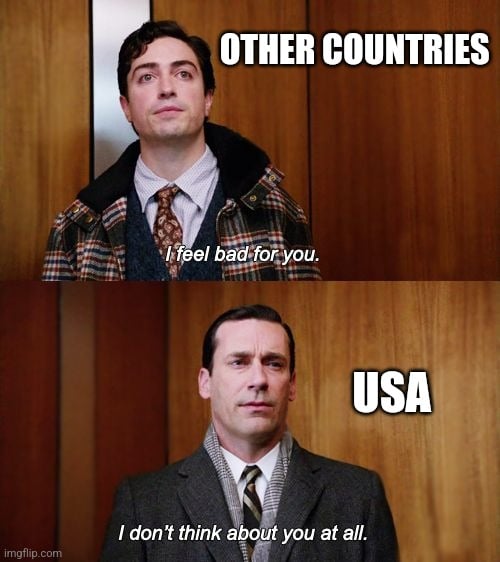
“I feel bad for you.”
“I don’t think about you at all”
ITT Europeans tell us shit we already know about changes most of us want because they don’t understand gerrymandering and the electoral college
You’re the “Old World” now.
It’s basically been 350 years now since US independence, and a decent while now at being a global power (~100-150 years?). These are timelines akin to that from the European Renaissance to the US Revolution (~1400-1800) and the UK emerging from the 1500s to being the “super power” in the war of independence.
Now, with the world’s oldest constitution, and probably, depending on who you talk to, an increasingly critical mass of antiquated ideals and systems, the Presidency is more like the Monarchs of past revolutions than what remains of those monarchies, and the US’s ideals and cultural influence something which most would rather move on and upgrade from.
Generally, I’d say it’s one of the weirder and subtler historical events happening right now: the dissolving of the old lines between the “old” and “new” worlds. For me personally, this was once made clear when visiting Hannover, Germany, and its tourist attraction, the “New Town Hall”, where someone who lives in British Columbia, Canada pointed out the similarities with their Parliament Building. The thing is though that the Canadian building is about 15 years older (both being just over 100 years old). Colonialism is long enough ago and Europe (and likely any other “old” culture, such as China) rebuilt enough and recently enough, that like X-genners and Millennials, the whole “young, hip, cool rebel” thing just doesn’t mean anything anymore.
It’s ironically like they have a small set of royal families that swap the throne every four years.
And the equivalent of dukes and earls traveling to Mar-a-lago to pledge fealty.
Wait a minute, that’s just monarchy with extra steps
In recent times, boomers have had a notable hold on the presidency. Not just boomers, but those born in the summer of 1946. Clinton, Bush Jr and Trump were all born between June and August 1946, a window of 3 months, but spanning over 3 decades of the White House. And the same more or less holds for the losing candidates too, with Harris and Obama being the major exceptions IIRC. Indicates to me some real oligarchical forces beyond what’s normal in the rest of the west.
Just correcting small typos. US has been independent for almost 250 not 350 years. Global power for 150ish but the global power for 70ish years :)
Ha yes, thanks … though, without knowing, I’d wonder how early you can push the global power part (thus the question mark). Post-war (your 70 years) is clearly a “the global power” status. But how early could you say the US was at least one of the major powers?
That’s an interesting question of which I’m ignorant. Your original comment may have been right though. It might be helpful to say a global power fights wars outside of its border and potentially colonizes. The first time the USA did that was the first Barbary war in 1801. Would you agree?
Yes they seem like reasonable metrics to me. But like you I don’t really know how to answer the question. But relative economic strength and influence are likely factors. So the post civil war gilded age would also been a likely point, which was the origin of my 150 yrs estimate. For 100 years, I figured post WWI was a pretty clear moment of relative strength.
Then I apologize for my wrong correction but I learned something with you through it :D
No worries at all!
Also, I didn’t know at all about the Barbary Wars (and was quite surprised to hear of such a far flung US military engagement so early)
capitalism is actually the worst possible system
For a growing economy with an excess of people and resources it’s pretty good.
Our current world, not so much.
The problem is that there isn’t a currently viable alternative.
Capitalist realism is a bitch.
There are plenty of viable alternatives; in isolation. The real problem is that capital will always intervene before an alternative can get a foothold.
Unregulated capitalism*
Capitalism in and of itself is a turbo charger for the economy, but like a real turbo charger it need regulations to not destroy itself and the engine.
that’s a pretty good metaphor but assumes regulatory capture isn’t baked into the cake and pulling up the ladder after consolidating all the wealth isn’t the entire point.
You are absolutely right, my comment assumed regulation and acting in good faith.
I am mainly just so tired of everyone just going “capitalism bad”, when that is not the single answer.
Eradicating capitalism would be terrible and idiotic.
I am a firm believer in a social democratic system with a well regulated free market.
You’re correct that everything is being held up by capitalism right now so if you remove it then everything collapses. We need to build alternative structures to hold things up before making any attempt on the current system, which should be as simple as using the alternatives instead but power was never given up without a fight.
I think market systems in general lead to exploitation and democracy is just the tyranny of the majority. We can do better and we should do better.
Democracy doesn’t have to be a tyranny of the majority. In its purest form it is. And that is why constitutional republics ensure citizen’s rights in their constitutions. We need a similar system for economy.
A sketch of that would a be a system where you’d have constitutional republic with independent legislature, judiciary and executive branches. Separated from the economic players as well as possible. They would provide the the outer bounds of a level playing field. Economy would a market economy, where ownership of companies would be distributed among the stakeholders of the system workers, customers and the executive. Similar to how governments ideally function. Workers would have “legislative” power in the company. They would be responsible for company policy. Executives would implement those policies. Customers would decide how well the company performs by either buying their products or withholding their patronage. This would need a lot of guard rails in place. But this would prevent centralization of power in the hands of an “owner”-class.
Transitioning to this type of system would not be that difficult. As most of what it has is already there. In western democracies. At least on paper. There would be a lot of resistance to this from the “owner”-class. I have no doubt of that.
a lot of guard rails
as always any system is only as good as the people perpetuating it.
The main reason US can and could ever delude itself into being great is for having a ridiculous people-to-land/resources ratio. There is nothing inherently great about how the US does things, it just seems that way because you can do whatever you want if you have essentially infinite resources compared to everyone else.
Seinfeld isn’t funny.